Works today · Field reviewed

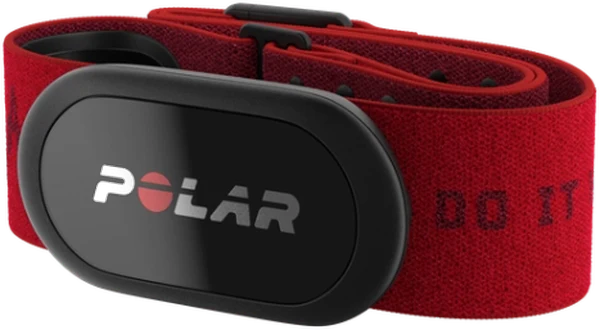
Polar H10 chest strap

Strong beat-to-beat data, with the everyday trade-off of wearing a chest strap.

Polar H10 chest strap
Overall HRV score9 / 10Provisional KörperForce field assessment · not a clinical accuracy rating

What our recordings show

In an initial sample, we reviewed 21 historical RR-interval exports from a much larger archive confirmed by the device owner to originate from the Polar H10. They span December 2017 to May 2021 (not continuous monitoring) and contain 4,872 beats, including 19 marked as corrected: 0.39% pooled. Seven individual sessions exceeded 1% corrections. Eight exports also show unusually quantized intervals, so the pooled figure applies only to this initial sample and needs a data-processing caveat; it is not a clinical accuracy percentage.

  • ECG-based RR intervals: the H10 senses electrical heart activity rather than estimating pulse timing optically.
  • Measured correction burden: 19 of 4,872 beats corrected (0.39% pooled) across the 21 reviewed exports, not across the full H10 archive; individual session rates vary.
  • Works with Live Sessions and HRV reports: standard Bluetooth heart-rate data, including usable RR intervals, can be recorded in Chrome or Edge on Mac and PC.
  • Main drawback is wearing it: fastening and positioning the strap takes extra effort, particularly when changing clothes or moving between clients.

Reliability score

KörperForce's provisional field assessment, informed by an initial sample of 21 user-confirmed H10-origin RR exports (December 2017–May 2021) and observed usability. These are practical 0–10 ratings, not clinical accuracy percentages. Aggregate counts are shown below; the raw session files and personal metadata are not published.

Heart rate

9 / 10

Electrical heart sensing provides a strong basis for reliable heart-rate readings when the electrodes have good contact.

HRV (rMSSD, SDNN)

9 / 10

Across 21 exports, 19 of 4,872 beats were corrected (0.39% pooled). Seven sessions exceeded 1%; eight other exports show quantized intervals that require further source-pipeline review. This does not independently establish RR accuracy.

LF/HF and coherence

9 / 10

Clean beat intervals are a strong foundation for longer HRV analysis windows. Spectral estimates still depend on sufficient recording duration, coverage and stable conditions.

Practicality

6 / 10

Reliable data comes with a chest strap that must be fitted and fastened. Placement can be inconvenient, and for some women it may be awkward beneath or around a sports bra. Comfort and fit vary by person.

Overall for HRV: 9 / 10 (provisional field assessment). Our strongest currently reviewed option for wearable ECG-based beat intervals. The score reflects observed data quality, while the practicality rating recognizes that not every client wants to wear a chest strap. Compare the Lightstone at 8 / 10 and Rhythm24 at 6 / 10.

Evidence behind this report card

These figures were recalculated from the supplied beat-level RR exports. The owner confirmed their original sensor was the H10; the files themselves label the device as "RR interval file." This is an internal analysis, not an independent ECG comparison.

Initial sample: 21 reviewed exports

These 21 selected H10-origin RR exports contain 4,872 beats from December 2017 to May 2021, totaling approximately 78 minutes of recorded intervals. The full historical H10 archive contains many more sessions; its total count and overall correction rate have not yet been calculated.

0.39% pooled correction rate

19 corrected beats out of 4,872 in the initial 21-export sample. Twelve sessions had zero corrections; seven exceeded 1% individually. This is not the full archive's correction rate, a per-session guarantee, or an accuracy percentage.

Processing caveat and open items

Eight exports (3,236 beats, zero flagged corrections) contain unusually quantized intervals. Excluding them, the other 13 sessions show 19 corrections in 1,636 beats (1.16%). The cause of quantization, firmware, activity conditions, raw-source processing, the full archive's aggregate correction rate, and synchronized ECG reference comparison remain unverified.

Interpretation: The exports report zero gaps, but they do not establish independent packet continuity. Eight sessions show BPM-like interval quantization; this may arise from an export or processing step, not necessarily from the H10 itself. A low correction rate does not prove accurate beat timing or complete coverage. These are provisional KörperForce field scores, not clinical validation.

How it works with KörperForce

Live HRV Sessions

Record live ECG-based RR intervals and HRV.

Workouts

Track HRV during activity with a secure strap.

Games

Play HRV biofeedback games; no SCL signal.

Live reports

View HRV trends, session data and reports.

All four HRV workflows use available beat-to-beat data. SCL-driven games require a sensor such as the Lightstone.

The human-factor trade-off

The H10's challenge is not primarily its beat data; it is the experience of putting on and wearing the device. A chest strap can be intrusive or inconvenient in group sessions, quick check-ins and workouts. For some women, positioning the band with a sports bra or other clothing adds another step. We account for that in the practicality score without treating fit or comfort as the same for everyone.

Polar and H10 are trademarks of their owner. KörperForce's score is an independent field assessment, not a manufacturer endorsement or a medical-device accuracy certification.